Mechanostereochemical modulation of polymer mechanical properties.
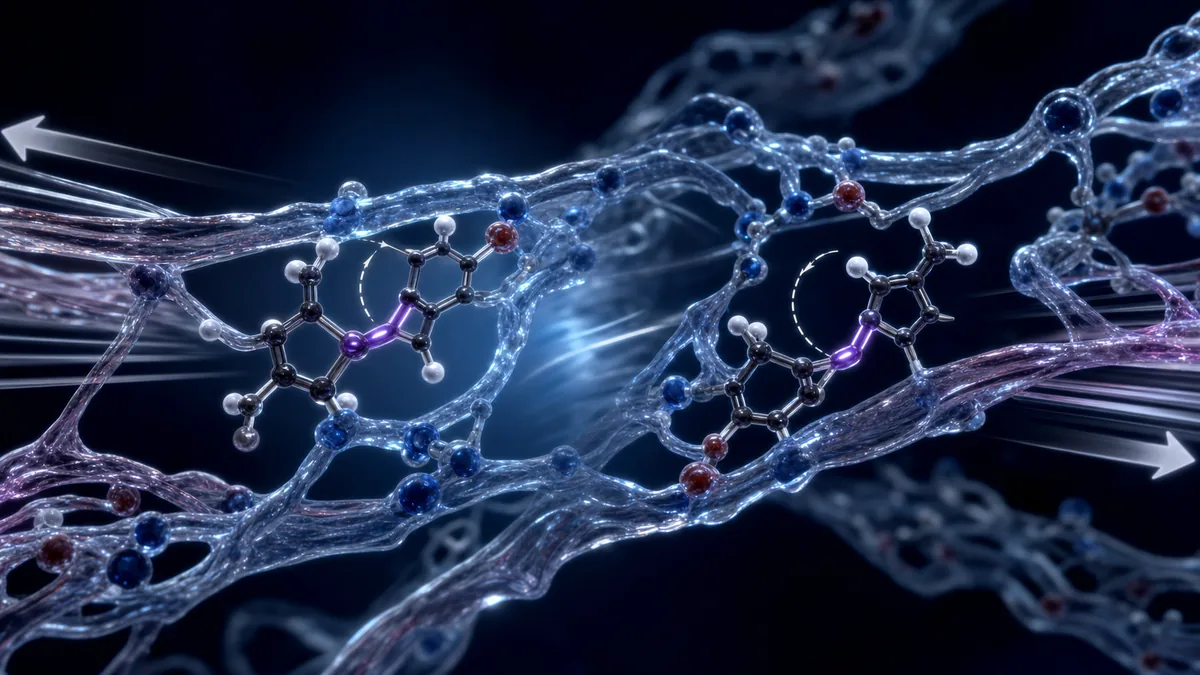
Stereochemistry profoundly affects the physical and mechanical properties of polymers, illustrated by the contrast between elastic natural rubber ( cis -polyisoprene) and the stiffer, less extensible gutta-percha ( trans -isomer). Traditional stereochemistry such as tacticity and cis / trans isomerism primarily governs polymer properties based on fixed structural or conformational factors. Herein, by incorporating the mechanostereochemistry concept into polymers, we demonstrate a stereochemistry
Stereochemistry profoundly affects the physical and mechanical properties of polymers, illustrated by the contrast between elastic natural rubber ( cis -polyisoprene) and the stiffer, less extensible gutta-percha ( trans -isomer). Traditional stereochemistry such as tacticity and cis / trans isomerism primarily governs polymer properties based on fixed structural or conformational factors. Herein, by incorporating the mechanostereochemistry concept into polymers, we demonstrate a stereochemistry paradigm wherein dynamic isomers dictate material properties, thereby defining the unprecedented transient-stereostructure-efficacy mechanism. Specifically, we engineer two mechanically interlocked networks based on [ c 2]daisy chains, where force-triggered intramolecular motion generates mechanostereoisomers with distinct geometric configurations: [ c 2]Daisy chain 1 in MIN- 1 contracts into a fisherman's knot, whereas [ c 2]daisy chain 2 in MIN- 2 extends into a loop. Due to reduced network elasticity from the loop structure, MIN- 2 exhibits a lower modulus in large-strain shear measurements and less pronounced strain hardening in tensile tests compared to MIN- 1 . Since these mechanostereoisomers are induced by force, material properties show strain-dependent character: both networks perform similarly under small or no strain, but diverge significantly at large strains. Our work expands the conceptual boundaries of polymer stereochemistry and provides insights for designing high-performance materials through stereochemical control.