Health & Medicine

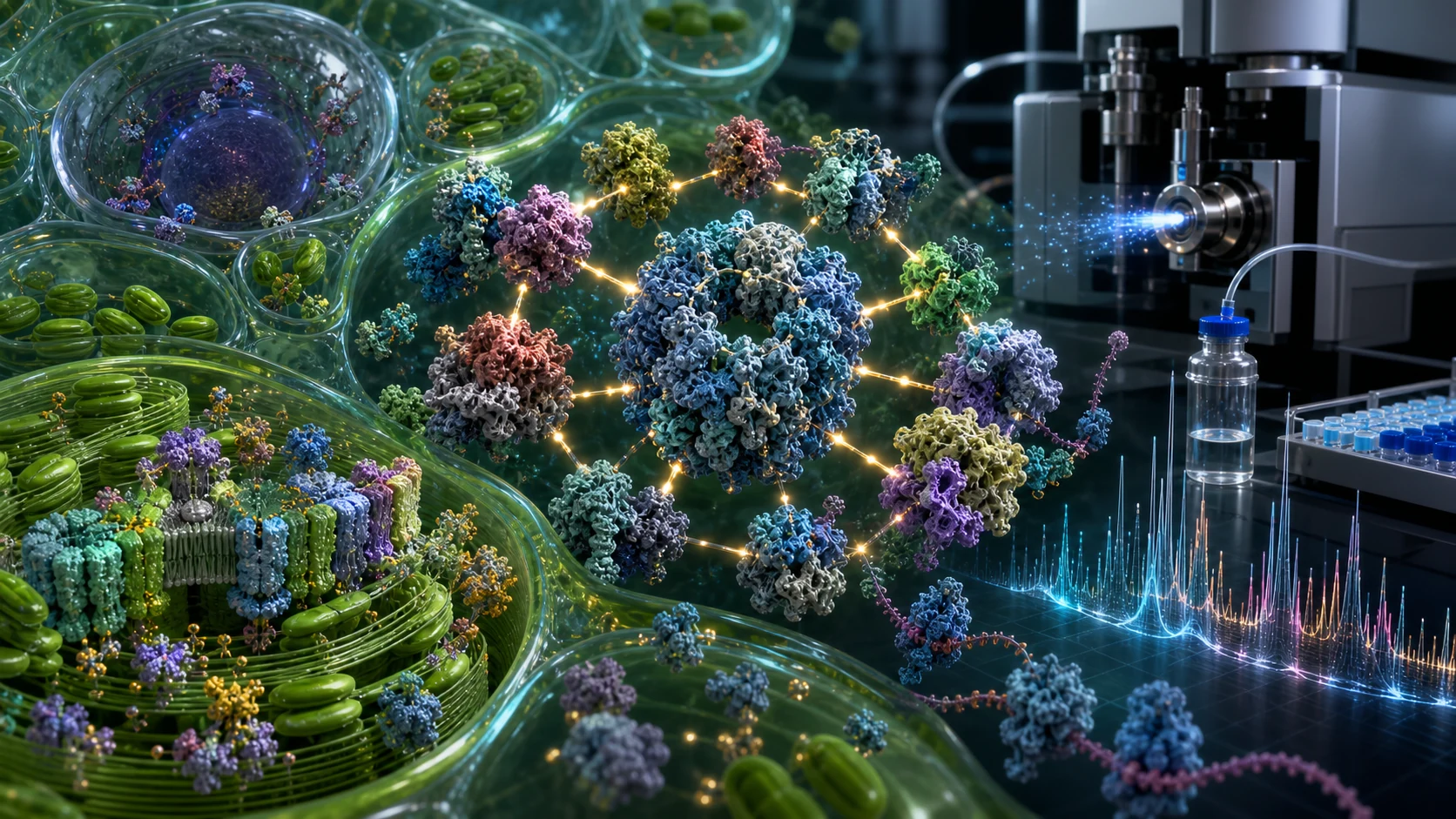
Mapping the architecture of protein complexes in Arabidopsis using cross-linking mass spectrometry.
| Source: Proceedings of the National Academy of Sciences of the United States of America

Capturing molecular machines in action is essential for understanding protein complex architecture, cellular regulation, and gene function. Here, we present a large-scale structural proteomics resource for Arabidopsis thaliana generated using an optimized cross-linking mass spectrometry workflow. Using the trifunctional cross-linker PhoX, whose phosphonic acid moiety enables immobilized metal affinity chromatography-based enrichment, we selectively enriched cross-linked peptides from whole-cell

Capturing molecular machines in action is essential for understanding protein complex architecture, cellular regulation, and gene function. Here, we present a large-scale structural proteomics resource for Arabidopsis thaliana generated using an optimized cross-linking mass spectrometry workflow. Using the trifunctional cross-linker PhoX, whose phosphonic acid moiety enables immobilized metal affinity chromatography-based enrichment, we selectively enriched cross-linked peptides from whole-cell lysates, chloroplasts, and nuclei. Analysis with pLink 3.2 identified 52,944 unique cross-linked peptide pairs, corresponding to 37,531 residue-level contacts across 5,064 proteins. These data define 3,083 protein-protein interactions, including 2,385 heteromeric and 698 homomultimeric interactions. Comparison with the Search Tool for the Retrieval of Interacting Genes/Proteins (STRING) database showed that 676 interactions are supported by STRING scores ≥0.9. Structural mapping to Protein Data Bank and AlphaFold models showed that most cross-links were within the expected 35 Å distance constraint. The dataset further enabled the analysis of protein connectivity and complex topology across diverse molecular assemblies, including the Rubisco holoenzyme, chloroplast 70S ribosome, photosystem complexes, and the cytosolic 80S ribosome together with associated biogenesis and regulatory factors. We also identified histone-associated complexes, including interactions involving an O-acyltransferase. By providing residue-level structural constraints for a substantial portion of the Arabidopsis proteome, this study provides a resource for exploring plant molecular machines and their spatial organization.

Read the original source →

Related Stories

Health & Medicine

PLASTID ENVELOPE ION CHANNELS (PEC1/2) link Ca 2+ and jasmonic acid signaling in plant cells.

Plants constantly encounter adverse environmental interactions. One organelle is particularly specialized in stress signaling and phytohormone synthesis: the plastid. Calcium (Ca 2+ ), a key second messenger, is known to intersect with cellular phytohormone signaling networks. While cytosolic Ca 2+ dynamics have been studied extensively, the physiological relevance of stromal Ca 2+ transients and the identity of channels mediating rapid Ca 2+ flux into plastids remain largely unexplored. In this

Continue reading
Health & Medicine

Detection of "hidden" mitotic crossovers by long-read DNA sequencing.

Mitotic crossovers in diploid organisms are usually detected by looking for loss of heterozygosity (LOH) for a marker. Assuming the crossover occurs between two duplicated chromatids, a single reciprocal crossover will result in two recombinant chromatids and two nonrecombinant chromatids. LOH will only be observed when a recombinant chromatid cosegregates with a nonrecombinant chromatid. Cells containing both recombinant chromosomes will not result in LOH. Below, we use long-range DNA sequencin

Continue reading
Health & Medicine

Amino acid homeostasis by CORVET/HOPS: A metabolic and stress resilience checkpoint for T cells.

Amino acid sufficiency is critical for T cell metabolic reprogramming, yet how T cells maintain amino acid homeostasis remains poorly defined. Here, we identify the CORVET and HOPS (CORVET/HOPS) tethering complexes as essential upstream regulators. In activated T cells, they sustain intracellular amino acid levels by promoting macropinocytosis to acquire extracellular nutrients. This function enables dual signaling outcomes: suppression of the integrated stress response (ISR) and activation of m

Continue reading
Health & Medicine

Bright monomeric fluorescent protein elite-niRFP704 for two-channel near-infrared STED nanoscopy.

The near-infrared (NIR) spectral region is attractive for live-cell imaging, due to low autofluorescence and reduced phototoxicity. Some phytochrome-derived fluorescent proteins absorb and emit fluorescence in the NIR, but have short fluorescence lifetimes and relatively low quantum yields, requiring higher laser powers thus limiting their usefulness for live-cell superresolution microscopy. Using the bacterial phytochrome miRFP703 as a template, we screened for variants with longer fluorescence

Continue reading
Health & Medicine

Quantitative nanoscale imaging shows peptide-MHC I complexes are monomeric and spatially regulated in human dendritic cells.

Major histocompatibility complex class I (MHC I) molecules present antigenic peptides to cytotoxic T cells, a process central to immune surveillance. However, the nanoscale spatial organization of peptide-MHC I (pMHC I) on human dendritic cells (DCs), key initiators of cytotoxic T cell responses, remains largely unexplored. Here, we combine high-affinity soluble T cell receptors with DNA-based point accumulation for imaging in nanoscale topography (DNA-PAINT) to quantitatively map and count defi

Continue reading