Environment

Geometry controls momentum flux in the sprinkler problem.
| Source: Proceedings of the National Academy of Sciences of the United States of America

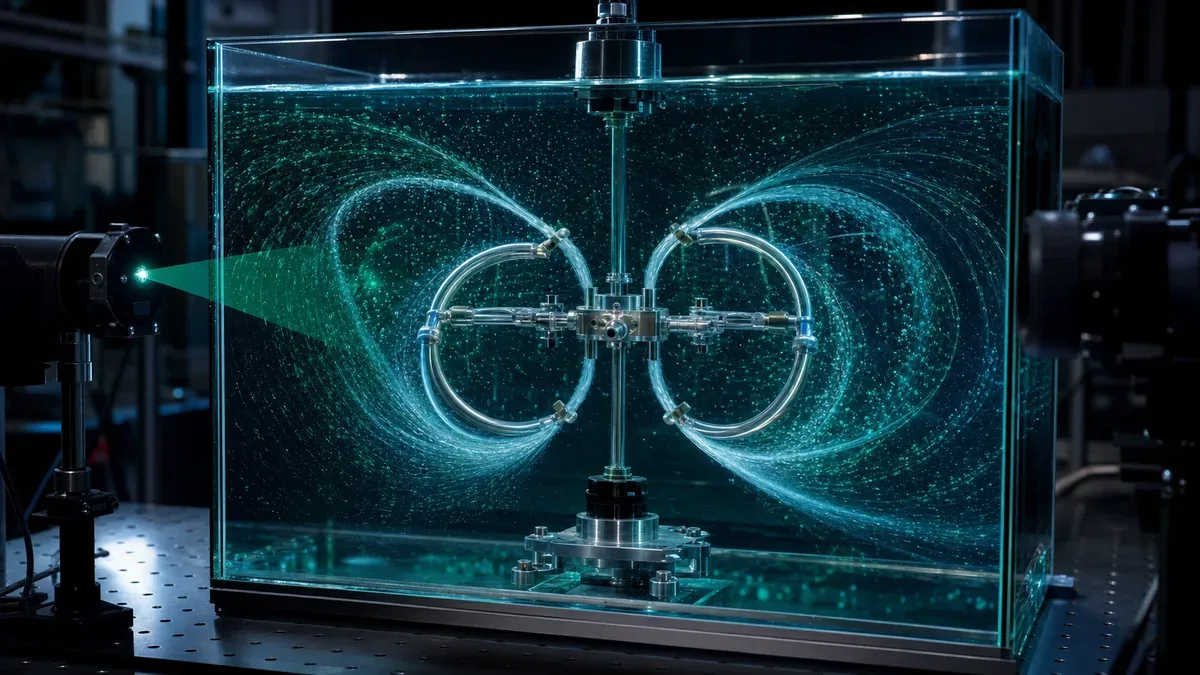
Hydro- and aero-mechanical devices convert fluid flows into useful motions, force, and power. The operating principles can involve subtle and poorly understood physics, as epitomized by open questions about systems that aspirate flows through curving tubular arms. Since its introduction by Mach and popularization by Feynman, the so-called reverse sprinkler problem has evoked many competing theories and fluid mechanical effects that have not to date been distinguished by experiments. Here we cond

Hydro- and aero-mechanical devices convert fluid flows into useful motions, force, and power. The operating principles can involve subtle and poorly understood physics, as epitomized by open questions about systems that aspirate flows through curving tubular arms. Since its introduction by Mach and popularization by Feynman, the so-called reverse sprinkler problem has evoked many competing theories and fluid mechanical effects that have not to date been distinguished by experiments. Here we conduct a series of experiments that directly report on the motions, torques, and flows for devices whose geometries are tailored to disambiguate the leading hypotheses. Our observations run counter to several ideas, such as those based on the total angular momentum of the fluid and others focusing on the flow and pressure distributions at the outer portions of the arms. The measurements instead reveal strong correlations between the sense of torque/rotation and the fluid momentum fluxing into the device. These results suggest an operating principle for the reverse sprinkler involving isotropic input of fluid from the far field and swirl-up in the arms that generates angular momentum, a residual portion of which is injected inside and drives rotation. The mass-to-momentum flux conversion is governed by the geometry of the curving arms. The physics learned here is fundamental to flow-structure interaction problems and may inform applications for harvesting and transforming flow energy.

Read the original source →

Related Stories

Environment

Reversing vegetable biodiversity loss to diversify diets.

Vegetables are a critical component of diets, with inadequate intake of this essential food group leading to poor dietary quality and malnutrition. Food system assessments identify insufficient production, comparatively high prices, and sociocultural barriers as key constraints to vegetable consumption. We argue that vegetable biodiversity, spanning vegetable species and their varieties, as well as their wild relative species, is a central yet underutilized lever for enhancing vegetable consumpt

Continue reading
Environment

Sediment accumulation rate predicts the temporal resolution of marine fossil assemblages.

Time averaging (TA), the mixing of noncontemporaneous organisms in fossil assemblages, governs the resolution of paleontological data and determines which biological and environmental processes are recorded in the geological record. To assess variation in TA and its dependence on external drivers, we used amino acid and radiocarbon methods to individually date 7,593 specimens across 384 samples from late Quaternary marine assemblages of calcifying organisms. Bivalve mollusks dominated the data,

Continue reading
Environment

Guanidine fuels rapid resurrection of desert cyanobacteria.

In desert ecosystems, microbial activity is driven by brief hydration pulses but is severely limited by persistent nutrient scarcity. Cyanobacteria serve as essential pioneer photoautotrophs, maintaining biogeochemical cycles and ecosystem stability in these arid landscapes. However, their ability to quickly reactivate after rehydration is critically restricted by nitrogen availability. Although the nitrogen demand can be met later by biological nitrogen fixation, it is ineffective and irrelevan

Continue reading
Environment

The unique Efg1 fungal virulence regulon in the catheterized bladder environment.

Urinary catheterization, a frequent procedure in hospitals, nursing homes, and other healthcare facilities, is a primary driver of nosocomial infections. The most common of these are catheter-associated urinary tract infections (CAUTIs), which often progress to severe complication, sepsis, and ultimately death. The fungus Candida albicans is a primary causative agent of CAUTIs; yet, its tissue-specific pathogenesis remains poorly understood, which complicates development of efficient treatments.

Continue reading
Environment

A unified machine-learning framework for ab initio multiscale modeling of liquids.

Understanding and predicting the behavior of liquid matter across length scales-using only the microscopic interactions encoded in the Schrödinger equation-remains a central challenge in the physical sciences. Achieving this goal requires not only an accurate and efficient description of intermolecular forces but also a consistent framework that bridges the micro-, meso-, and macroscales. Here, by combining machine-learned interatomic potentials (MLIPs) with neural classical density functio

Continue reading