Evolution of flowering phenology over 44 years of climate change.
Evolution is expected to be crucial for the persistence of some populations exposed to changing climate, but demonstrations of rapid evolution in wild populations associated with ongoing climate change are scarce. Inferences about possible adaptive responses rest heavily on "space-for-time" approaches that are fraught with assumptions that are difficult to verify. In contrast, resurrection experiments offer a direct method to observe evolutionary changes over time but rarely span the periods of
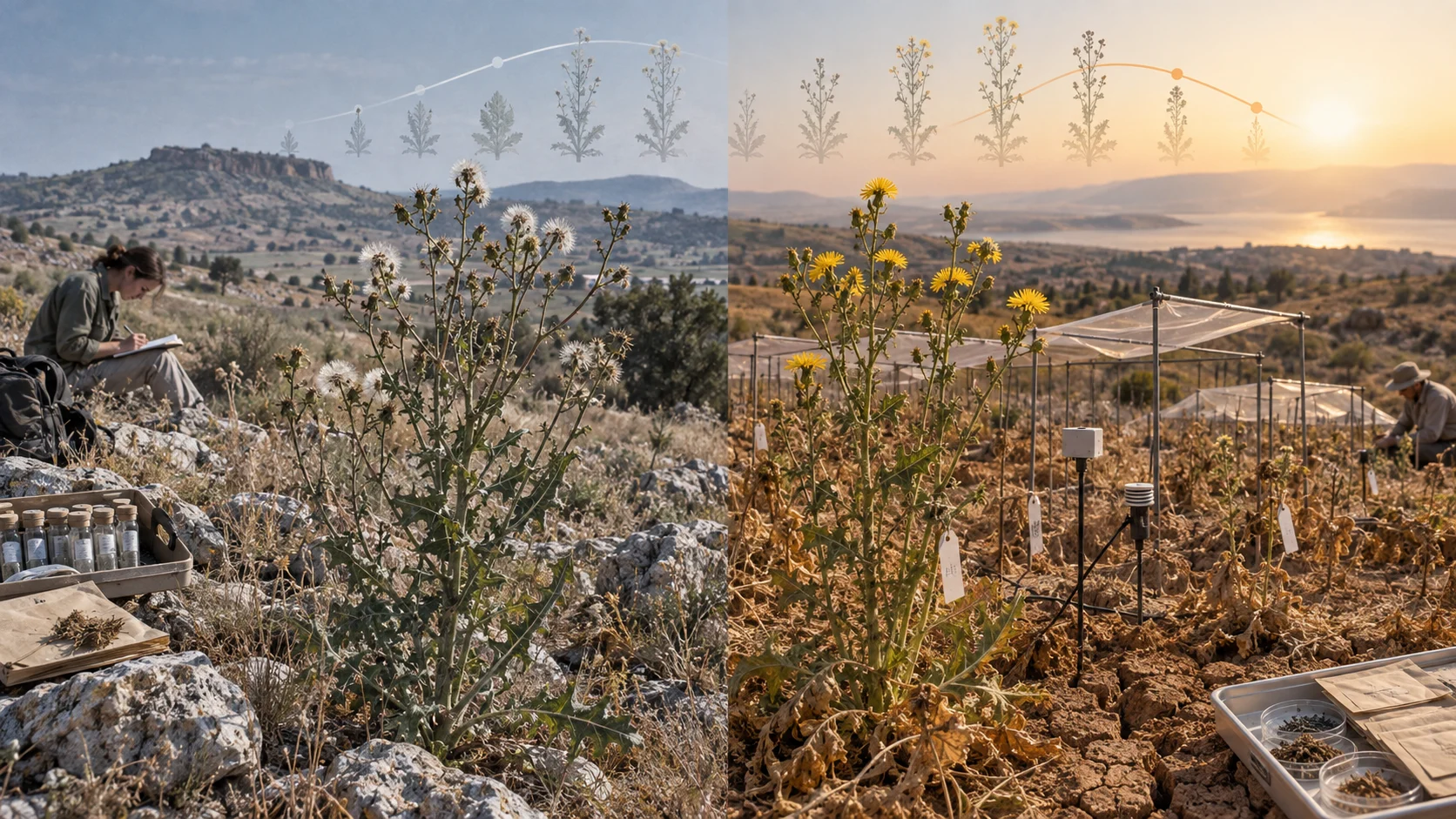
Evolution is expected to be crucial for the persistence of some populations exposed to changing climate, but demonstrations of rapid evolution in wild populations associated with ongoing climate change are scarce. Inferences about possible adaptive responses rest heavily on "space-for-time" approaches that are fraught with assumptions that are difficult to verify. In contrast, resurrection experiments offer a direct method to observe evolutionary changes over time but rarely span the periods of several decades over which climatic shifts have occurred. In this study, we integrated space-for-time, environmental manipulation, and resurrection experiments to investigate the evolution of the annual plant Lactuca serriola following 44 years of climate change in Israel and the Golan Heights. We found that contemporary plants flowered over 7 d earlier, a putative adaptation to increasingly warm and dry conditions, and also flowered earlier under experimental drought. However, in contrast to these patterns, plants originating from wetter populations flowered earlier than those from drier populations, indicating a mismatch between space-for-time predictions and observed temporal shifts in phenology. Our findings provide direct evidence for evolution in response to climate change in a wild species, while cautioning against applying predictions made from space-for-time studies to future climate change responses.