Coronary CT Angiography versus Intravascular Ultrasound Guidance for PCI.
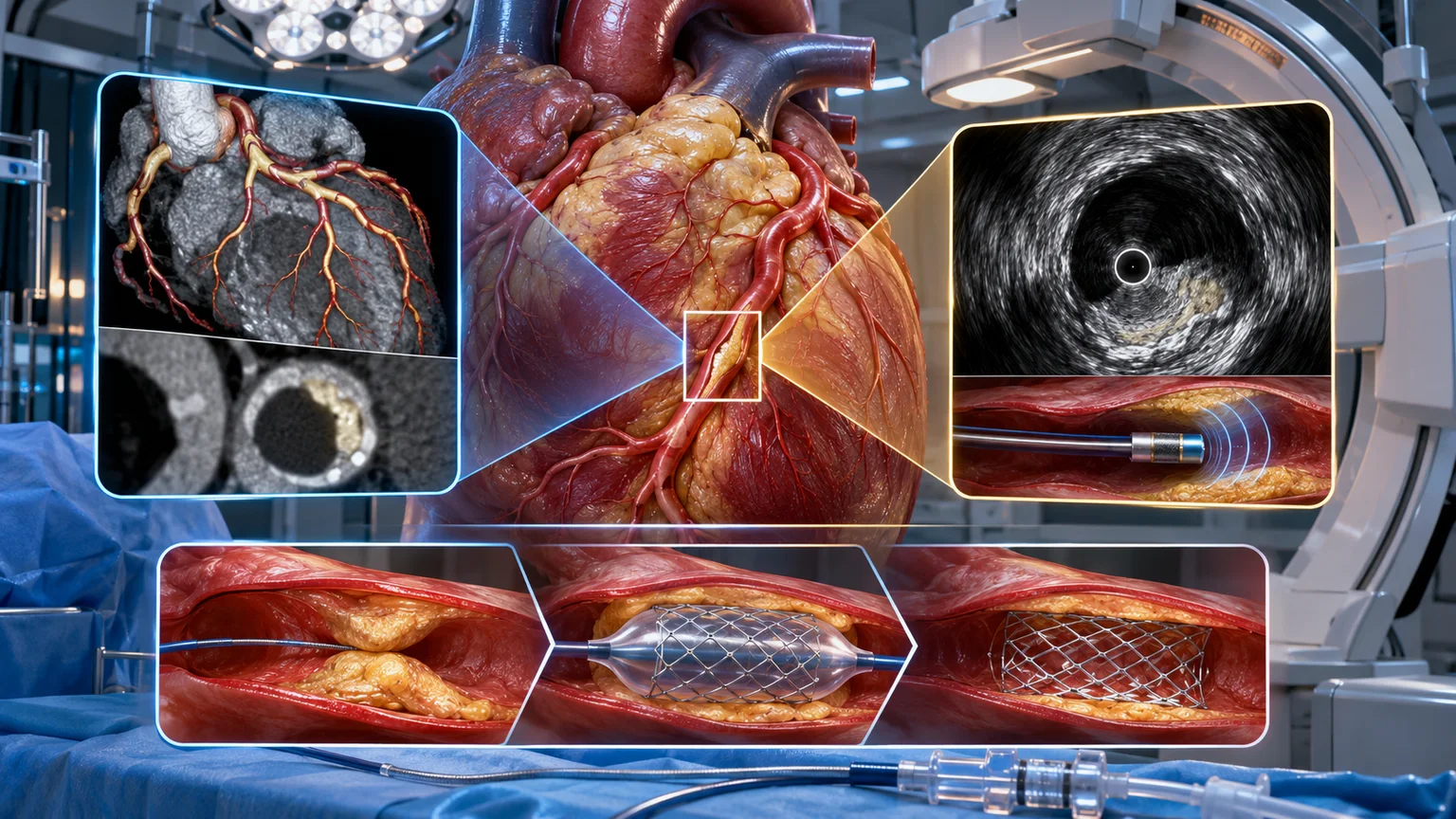
Intravascular ultrasound (IVUS)-guided percutaneous coronary intervention (PCI) improves clinical outcomes. Coronary computed tomographic angiography (CCTA) provides anatomical and physiological information before cardiac catheterization that may enable PCI planning. Data regarding the use of CCTA-guided PCI as compared with IVUS-guided PCI with respect to clinical outcomes are lacking. In this investigator-initiated, international, open-label, randomized, noninferiority trial with blinded end-p
Intravascular ultrasound (IVUS)-guided percutaneous coronary intervention (PCI) improves clinical outcomes. Coronary computed tomographic angiography (CCTA) provides anatomical and physiological information before cardiac catheterization that may enable PCI planning. Data regarding the use of CCTA-guided PCI as compared with IVUS-guided PCI with respect to clinical outcomes are lacking. In this investigator-initiated, international, open-label, randomized, noninferiority trial with blinded end-point adjudication, we randomly assigned patients with a clinical indication for revascularization, at least one epicardial lesion with a diameter stenosis of more than 70%, and a fractional flow reserve derived from CCTA of 0.80 or less in a 1:1 ratio to a CCTA-guided or IVUS-guided PCI strategy. The primary end point was target-vessel failure, defined as a composite of death from cardiac causes, target-vessel myocardial infarction, or ischemia-driven target-vessel revascularization, at 12 months. The noninferiority margin for the absolute risk difference was 4.5 percentage points, with a prespecified hierarchical testing strategy for superiority. A total of 1105 patients underwent randomization: 556 to the CCTA-guided PCI group and 549 to the IVUS-guided PCI group. The median age of the patients was 65 years, and 21.7% were women. At 12 months, target-vessel failure had occurred in 23 patients (4.1%) in the CCTA-guided PCI group and in 25 patients (4.6%) in the IVUS-guided PCI group (risk difference, -0.42 percentage points; 95% confidence interval, -2.82 to 1.99; P<0.001 for noninferiority; P = 0.73 for superiority). A total of 6 patients in the CCTA-guided PCI group and 9 patients in the IVUS-guided PCI group had clinical procedural complications. A CCTA-guided PCI strategy was noninferior to IVUS-guided PCI with respect to target-vessel failure at 12 months. (Funded by GE HealthCare and Heartflow; P4 ClinicalTrials.gov number, NCT05253677.).