Chiral 3d-4f Clusters with NIR-III Magneto-Optical Activity Driven by Lanthanide f-f Transition.
Chiral molecular materials with strong magneto-optical responses in the near-infrared III (NIR-III, 1600-2500 nm) region are attractive for applications in photonics, biomedicine, and advanced optical materials, but molecular magneto-optical phenomena in this spectral window remain largely unexplored. Here, we report six pairs of chiral 3d-4f molecular clusters, R/S -Ln 3 Mn 4 and R/S -Ln 12 Mn 12 (Ln = Ho III , Tb III , and Y III ), and systematically investigate their chiroptical and magneto-o
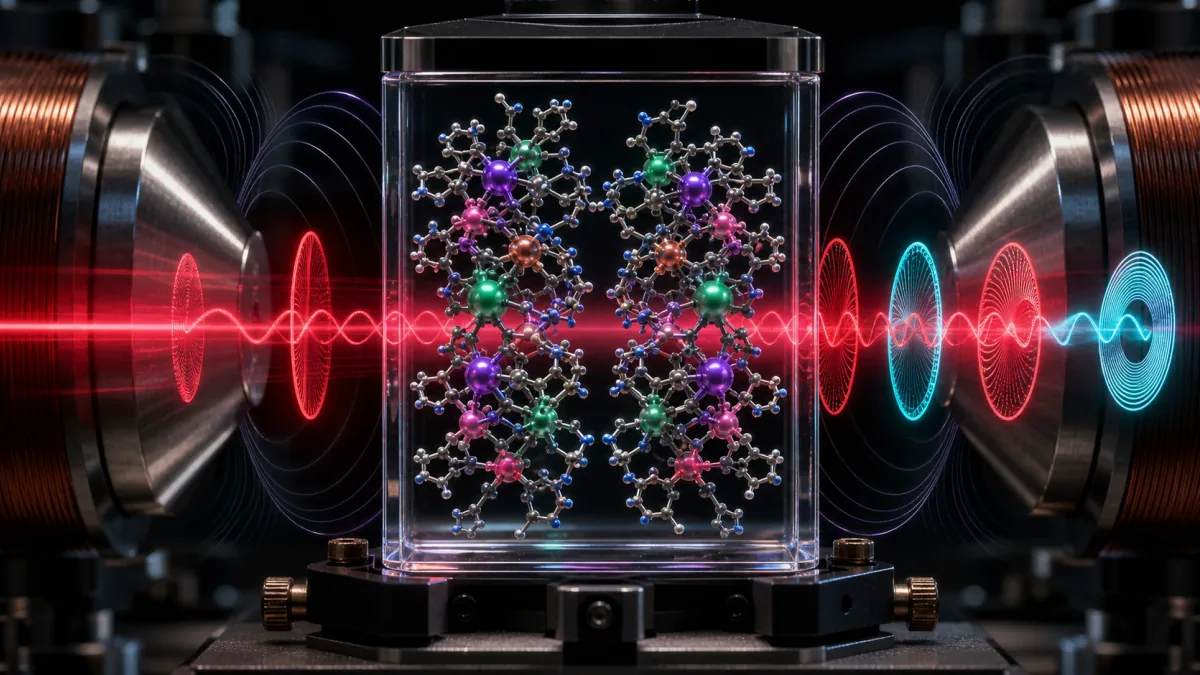
Chiral molecular materials with strong magneto-optical responses in the near-infrared III (NIR-III, 1600-2500 nm) region are attractive for applications in photonics, biomedicine, and advanced optical materials, but molecular magneto-optical phenomena in this spectral window remain largely unexplored. Here, we report six pairs of chiral 3d-4f molecular clusters, R/S -Ln 3 Mn 4 and R/S -Ln 12 Mn 12 (Ln = Ho III , Tb III , and Y III ), and systematically investigate their chiroptical and magneto-optical properties in the NIR-III region. Circular dichroism (CD) and magnetic circular dichroism (MCD) spectroscopy reveal that R/S -Ho 3 Mn 4 and R/S -Ho 12 Mn 12 clusters exhibit pronounced CD and MCD responses in the NIR-III region arising from long-wavelength Ho III f-f transitions, whereas R/S -Tb 3 Mn 4 and R/S -Tb 12 Mn 12 show strong MCD responses but no resolved CD signals. These findings identify long-wavelength lanthanide f-f transitions as the origin of the NIR-III chiroptical and magneto-optical activity. Notably, the R/S -Ln 12 Mn 12 series exhibits larger g MCD values and stronger NIR-III MCD responses than the corresponding R/S -Ln 3 Mn 4 analogues. This enhancement may arise from the change in local Ln III coordination geometry from D 4 d in Ln 3 Mn 4 to D 2 d in Ln 12 Mn 12 , which favors a stronger Zeeman-perturbed MCD response, along with cooperative Ln III -Mn II weak magnetic interactions in Ln 12 Mn 12 . This work provides the first molecular example of f-f-transition-driven chiroptical and magneto-optical activity across the NIR-III window and establishes chiral 3d-4f clusters as structurally defined platforms for tuning long-wavelength magneto-optical responses.