Economics

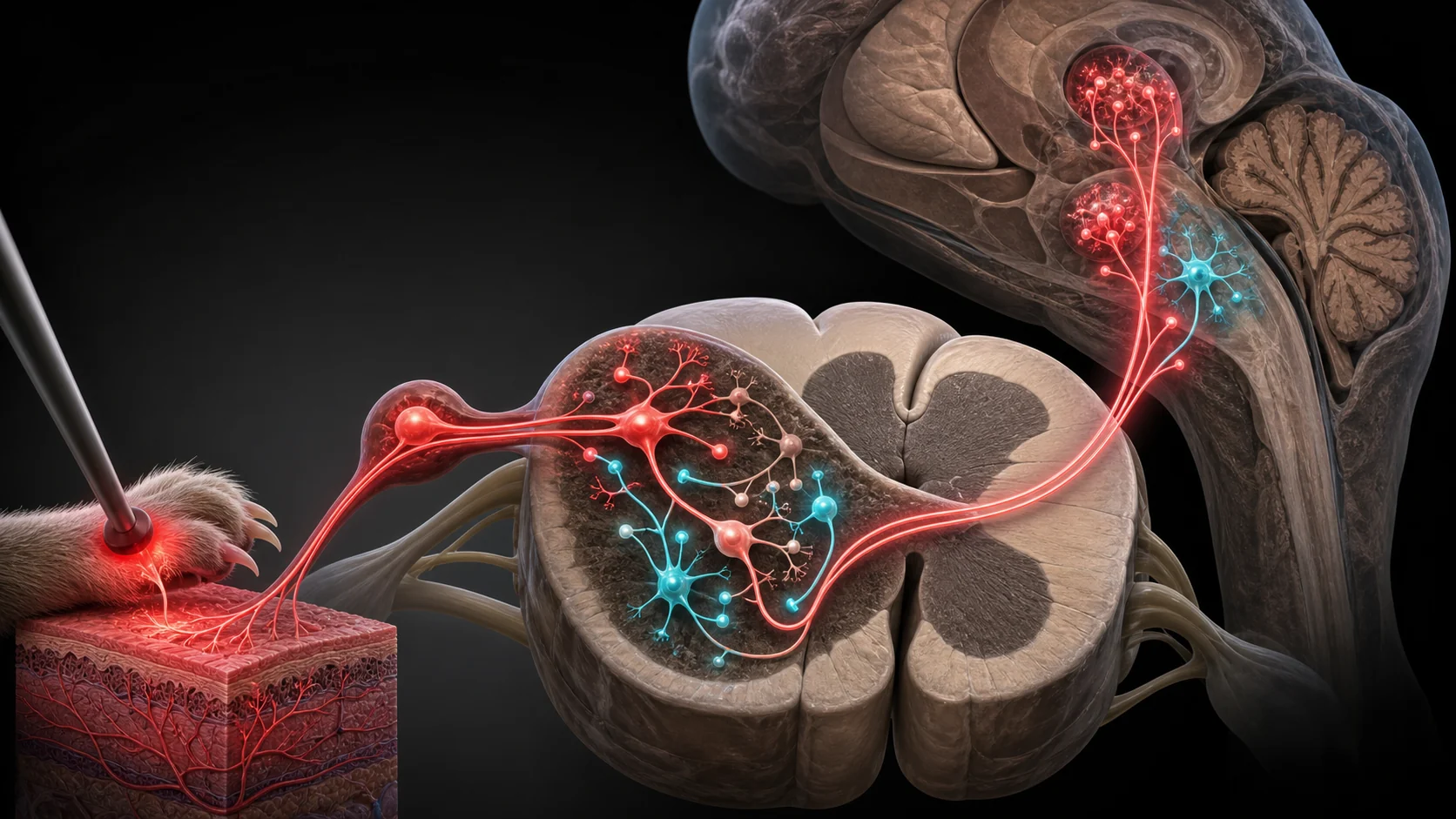
A spinoreticular pathway mediates nocifensive responses to noxious mechanical stimuli.
| Source: Proceedings of the National Academy of Sciences of the United States of America

Spinal projection neurons (SPNs) relay somatosensory information to the brain, yet how molecularly defined SPN subsets transmit noxious mechanical signals to drive nocifensive behaviors remains unclear. Here, we identify Sncg -expressing SPNs ( Sncg + SPNs) that convey noxious mechanical signals through a spinoreticular ascending pathway. Using intersectional genetics, anatomical tracing, and pathway-specific manipulations in mice, we show that Sncg + SPNs project predominantly to the parabrachi

Spinal projection neurons (SPNs) relay somatosensory information to the brain, yet how molecularly defined SPN subsets transmit noxious mechanical signals to drive nocifensive behaviors remains unclear. Here, we identify Sncg -expressing SPNs ( Sncg + SPNs) that convey noxious mechanical signals through a spinoreticular ascending pathway. Using intersectional genetics, anatomical tracing, and pathway-specific manipulations in mice, we show that Sncg + SPNs project predominantly to the parabrachial nucleus and the lateral reticular nucleus (LRN). Functional analyses reveal that Sncg + spinoreticular pathway transmits noxious mechanical information. LRN neurons receiving Sncg + spinal input are required for nocifensive behaviors elicited by noxious mechanical stimulation and contribute to mechanical allodynia of neuropathic pain. Monosynaptic tracing identifies local interneurons innervating Sncg + SPNs, providing a substrate for spinal gating of ascending mechanical signals. These findings highlight a spinoreticular circuit involving the LRN that is essential for nocifensive behaviors to noxious mechanical stimuli.

Read the original source →

Related Stories

Economics

Ancient DNA challenges to admixture narratives: Insights from Notre-Dame Cemetery (1683-1796) in Colonial Montreal, Canada.

Historical narratives of early colonization in Quebec frequently portray French-Indigenous relations as cooperative and characterized by admixture; which are often mobilized in modern debates on false-indigeneity. These narratives have been studied through genealogical, genetic, and bioarchaeological analyses, yet individuals of African descent remain mostly absent from them, while Indigenous peoples are framed largely in relation to colonists. Notre-Dame Cemetery (1683-1796) in Tiohtià:ke-

Continue reading
Economics

Understanding consciousness (biological and artificial) as a society of self-schemas.

This article argues that human cognition is more than the performance of functions such as memory, decision-making, and attention. The brain also builds schematic models of those cognitive functions and uses those models to monitor, predict, and partially control them. When you introspect, your understanding of who you are and what is happening inside of you is derived from those schematic, sometimes inaccurate, but generally useful models, rather than from the actual cognitive functions that ar

Continue reading
Economics

Hyperfunction of PSD-95 leads to hyperexcitability and cognitive abnormalities in MEF2C haploinsufficiency.

Myocyte enhancer factor 2C (MEF2C) is a transcription factor critical for brain circuit development and cognitive behavior. The loss of one copy of MEF2C leads to MEF2C haploinsufficiency syndrome (MCHS), a neurodevelopmental disorder characterized by intellectual disability, epilepsy, and behavioral phenotypes associated with autism spectrum disorders. Given that numerous genes are regulated by MEF2C, the neuronal and behavioral deficits in MCHS are complex, and there is currently no effective

Continue reading
Economics

Interventions to mitigate post-infection morbidity: Management insights from simple models.

A variety of pathogens that cause acute disease can also affect their host long after recovery. These post-infection effects lead to elevated costs for individuals and societies, which can be mitigated by large-scale interventions. Here, we examine the management of post-infection morbidity with mathematical models. First, we show that long-term usage of nonpharmaceutical interventions can reduce post-acute burden. Second, to investigate how post-infection effects affect optimal vaccination cove

Continue reading
Economics

Reproducibility of social science research using aggregate statistics with noise infused for differential privacy.

Privacy-preserving analytics such as differential privacy are designed to allow the analysis of sensitive datasets while protecting individuals' privacy. Their deployment, however, has been controversial. Critics maintain that statistical noise injected to preserve privacy can degrade the quality and feasibility of social science research. We select a benchmark of empirical findings from 93 published social science studies involving regression analyses over aggregate statistics. We evaluate whet

Continue reading