Society & Culture

4000-year-old painted plaque from Southeast Indonesia reveals Austronesian Painting Tradition preceded Neolithic pottery.
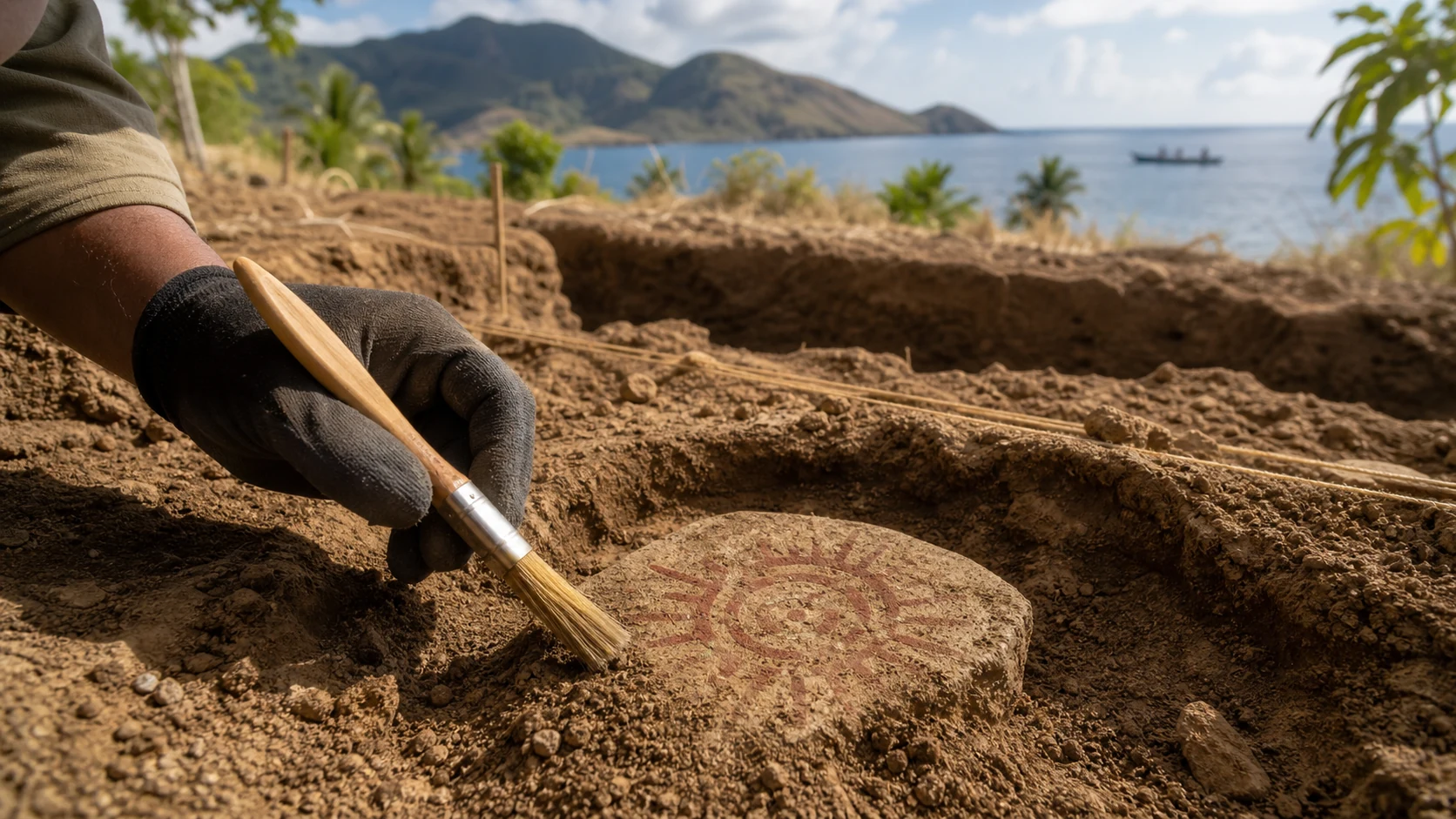
| Source: Proceedings of the National Academy of Sciences of the United States of America

The Austronesian dispersal is the largest such event in human history, with descendants of people from Taiwan colonizing islands from Rapa Nui to Madagascar. The extent to which this dispersal was facilitated by an economic package or a particular ideology is uncertain. The "Austronesian Painting Tradition" (APT) is a distinctive rock art style dominated by paintings of small human figures, boats, and geometric motifs found in eastern Wallacea and islands around New Guinea. The age of the APT is

The Austronesian dispersal is the largest such event in human history, with descendants of people from Taiwan colonizing islands from Rapa Nui to Madagascar. The extent to which this dispersal was facilitated by an economic package or a particular ideology is uncertain. The "Austronesian Painting Tradition" (APT) is a distinctive rock art style dominated by paintings of small human figures, boats, and geometric motifs found in eastern Wallacea and islands around New Guinea. The age of the APT is thus far poorly constrained, with uncertainty over whether it appeared endogenously through earlier Holocene interisland networks, if it arrived with the earliest Austronesian migrants, or if it appeared during the intensified interisland contact of the Indonesian Metal Age beginning ~2,500 y ago. Here we report the recovery of a painted stone plaque excavated in situ from archaeological excavation on Wetar Island, Maluku. The plaque occurs in a transitional layer between Paleolithic and Neolithic occupation. It bears a classic "Austronesian" red concentric circle and sun-ray motif and is dated to between 4090 and 3900 cal. BP, significantly earlier than the first pottery at the site and in this region. The early date for this plaque in a preceramic layer and its location in southeast Maluku supports the view that the APT had an early origin, and that the Austronesian diaspora was either propelled by or leveraged a compelling symbolic ideology.


Read the original source →

Related Stories

Society & Culture

Cerebellar microcircuits enable robust evidence-based decisions through cortico-cerebellar coupling.

The cerebellum is increasingly implicated in perceptual decision-making, yet it remains unclear how the cerebellar cortex can support sparse evidence accumulation over behavioral time scales without assuming cortical-style dense local excitatory recurrence. We present a biologically constrained modeling framework showing that cerebellar microcircuits can implement graded accumulation and competition in the absence of such recurrence. In our model, type-II Purkinje-neuron excitability generates f

Continue reading
Society & Culture

Loss of neuronal population organization links pathology to behavior in a model of Alzheimer's disease.

Alzheimer's disease and related dementias are typically described at two levels: the accumulation of molecular pathology and the emergence of cognitive impairment. Understanding the relationship between pathology, often studied in animal models, and human cognition will require measurements spanning intermediate scales, including single neurons, neuronal populations, and distributed networks. Here we combine longitudinal measurements of behavior and neuronal population activity with fluid and hi

Continue reading
Society & Culture

A spinoreticular pathway mediates nocifensive responses to noxious mechanical stimuli.

Spinal projection neurons (SPNs) relay somatosensory information to the brain, yet how molecularly defined SPN subsets transmit noxious mechanical signals to drive nocifensive behaviors remains unclear. Here, we identify Sncg -expressing SPNs ( Sncg + SPNs) that convey noxious mechanical signals through a spinoreticular ascending pathway. Using intersectional genetics, anatomical tracing, and pathway-specific manipulations in mice, we show that Sncg + SPNs project predominantly to the parabrachi

Continue reading
Society & Culture

Genomes of Poaceae relatives reveal key metabolic innovations preceding the evolution of grasses.

The grass family (Poaceae) has immense economic and ecological importance and exhibits distinctive metabolic traits, including dual starch and lignin biosynthetic pathways. We sequenced the genomes of Pharus , Joinvillea , Ecdeiocolea , and Typha species to investigate when and how these metabolic innovations evolved relative to the origin of the grass family. The rho whole-genome duplication (ρWGD) within the lineage that led to the last common ancestor of all grasses contributed to the g

Continue reading
Society & Culture

Cascading continental-scale floods across Europe in 1342-1343.

Europe has experienced extreme floods in recent decades. However, even larger floods are possible and must be considered in flood risk management 1,2 . Their characteristics can be clarified by analysing the largest documented historical floods. In Central Europe, the Magdalena Flood of July 1342 is usually considered the largest of the last millennium; however, knowledge of its characteristics is incomplete 3-7 . Here we show that 16 major flood events occurred across much of Europe between lat

Continue reading